7 Meta Ads Strategies for Beginners to Grow a Small Business
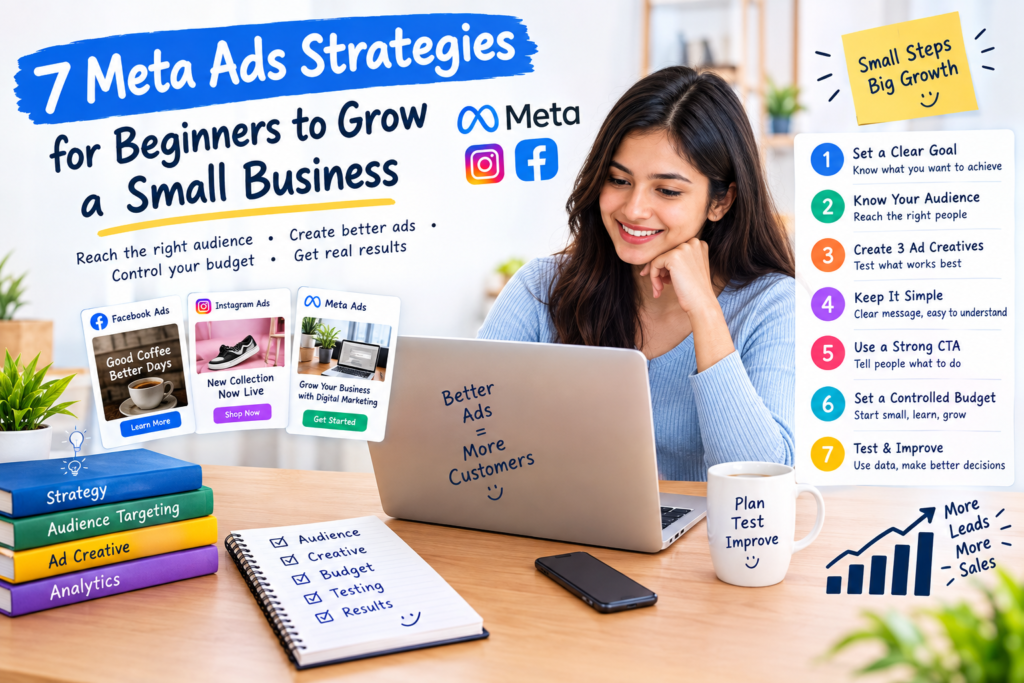
Getting customers online can be hard.
7 Meta Ads Strategies for Beginners
You may have a great product. You may offer a useful service. You may also have an active social media page.
But there is still one big question.
How will people discover your business?
One way businesses try to reach new customers is through paid advertising.
Meta Ads can help businesses promote products, services, offers, websites, and other business goals. Meta’s advertising system allows advertisers to choose campaign goals, set budgets, select audiences, add creative content, and measure results.
However, running an ad does not automatically mean you will get customers.
A successful campaign needs planning.
You need to understand your audience. You need a clear offer. You need useful ad content. You also need to watch your numbers and improve your campaign over time.
In this guide, we will explore 7 Meta Ads strategies for beginners. We will also cover ad formats, audience targeting, budgeting, important metrics, landing pages, common mistakes, and a simple campaign plan.
What Are Meta Ads?
7 Meta Ads Strategies for Beginners
Meta Ads are paid advertisements created through Meta’s advertising tools.
Businesses can use them to promote different types of offers.
For example:
- Products
- Services
- Websites
- Lead forms
- Special offers
- Events
- Online content
- Business pages
Imagine that you own a small clothing store.
You have a new festive collection.
Posting about it on your social media page may reach some followers. But you may also want to introduce the collection to people who do not already follow your page.
Paid advertising gives you another way to promote the offer.
You could create an advertisement showing your new collection and send interested people to your website or another destination.
The same basic idea can work for many types of businesses.
A salon can promote a service.
A coaching centre can promote a course.
A digital marketing agency can promote its services.
An online store can promote a product.
The campaign goal, audience, creative, and measurement method should match the business.
7 Meta Ads Strategies for Beginners
Why Do Businesses Use Meta Ads?
There are many reasons a business may use paid social advertising.
7 Meta Ads Strategies for Beginners
1. To Reach New People
A business may want to introduce itself to people who have never heard of it before.
2. To Generate Leads
Service businesses can use campaigns to encourage potential customers to submit their details.
3. To Promote Products
Online stores can advertise products and send interested users to relevant pages.
4. To Get Website Traffic
A business may want more people to visit an important page.
5. To Start Conversations
Some businesses prefer customers to ask questions before making a decision.
6. To Promote an Offer
A special package, discount, event, or launch can be promoted through an advertisement.
The right goal depends on what the business actually wants.
Meta’s current campaign setup uses objectives and performance goals to guide delivery toward the desired action.
7 Meta Ads Strategies for Beginners
7 Meta Ads Strategies for Beginners
1. Start With One Clear Goal
The first step is to decide what you want your advertisement to achieve.
Many beginners make the mistake of trying to achieve everything with one campaign.
They want:
- More followers
- More website visits
- More leads
- More sales
- More messages
- More engagement
That can make the campaign difficult to plan.
Instead, start with one main goal.
For example:
Goal: Generate leads
Now your campaign can be built around getting potential customers to submit their details.
Another business may have:
Goal: Get website visitors
Its advertisement can focus on getting people to visit a specific page.
Example
7 Meta Ads Strategies for Beginners
Imagine a digital marketing agency wants more enquiries from small businesses.
Instead of creating an advertisement that simply says:
“We are a digital marketing agency.”
The agency could create a campaign around a clear action:
“Want more customers from online marketing? Send us a message to learn how we can help.”
The campaign has a clear purpose.
Ask Yourself These 3 Questions
Before launching an advertisement, ask:
1. What do I want people to do?
2. Who do I want to take that action?
3. How will I know if the campaign worked?
These questions can help you build a more focused campaign.
7 Meta Ads Strategies for Beginners
2. Understand Your Target Audience
7 Meta Ads Strategies for Beginners
Your product is not necessarily for everyone.
A local restaurant and an online software company may have completely different audiences.
Understanding your customer can help you create a better message.
Think about:
- Location
- Age group
- Interests
- Needs
- Problems
- Business type
- Buying habits
- Product interest
Example: Local Business
7 Meta Ads Strategies for Beginners
Imagine you own a salon in Delhi.
Your advertisement should be relevant to people who can actually visit your salon.
You may want to focus on your service area rather than showing the advertisement to people who live very far away.
Example: Online Business
Now imagine you sell an online course.
Your potential audience may be much larger because people can access the course from different locations.
The campaign should match the way the business operates.
Understand the Customer’s Problem
Do not only think about demographics.
Think about problems too.
For example:
A small business owner may think:
“I am getting website visitors, but very few people contact me.”
A digital marketing agency could use this problem in its ad message.
The advertisement could begin with:
“Getting website visitors but not enough enquiries?”
This feels more relevant than simply saying:
“We provide digital marketing services.”
3 Questions to Understand Your Audience
Ask:
What problem does my customer have?
What does my customer want?
What may stop my customer from taking action?
The answers can help you create a stronger advertisement.
3. Create 3 Different Ad Creatives
7 Meta Ads Strategies for Beginners
7 Meta Ads Strategies for Beginners
Do not depend on only one creative.
A creative can be an image, video, carousel, or another visual format used in the advertisement.
Testing different creative ideas can help you learn what your audience responds to.
Meta’s current guidance recommends testing different images and videos and using A/B testing to improve creative performance.
Start with 3 different concepts.
Creative 1: Problem-Based
“Not getting enough customers online?”
The visual could show a business owner looking at low website enquiries.
Creative 2: Benefit-Based
“Reach more potential customers with digital marketing.”
The visual could show website traffic, leads, and business growth concepts.
Creative 3: Offer-Based
“Get 10% off selected digital marketing services.”
The visual could highlight the offer clearly.
These three advertisements use different angles.
One focuses on the problem.
One focuses on the benefit.
One focuses on the offer.
Test Different Formats
You can also experiment with:
- Static image
- Short video
- Carousel
A video may work well for explaining a service.
An image may work well for a simple offer.
A carousel can be useful when you want to explain several points.
The important part is to test rather than assume.
4. Keep Your Ad Message Simple
7 Meta Ads Strategies for Beginners
People often scroll quickly through social media.
Your advertisement should communicate its main point quickly.
You do not need to explain your entire business in one advertisement.
One useful structure is:
Problem → Solution → Benefit → Action
Example
7 Meta Ads Strategies for Beginners
Problem:
“Your business is online, but customers are not finding you?”
Solution:
“Our digital marketing service helps small businesses improve their online visibility.”
Benefit:
“Build a stronger online presence and reach more potential customers.”
Action:
“Contact us to learn more.”
This gives the reader a simple path.
Another Formula
You can also use:
Question → Answer → CTA
For example:
“Want more leads from your website?”
“Use a focused digital marketing strategy built around your target customers.”
“Learn More.”
Keep the message connected to your actual offer.
Do not make promises that your business cannot support.
5. Use a Clear Call to Action
A call to action, or CTA, tells people what to do next.
7 Meta Ads Strategies for Beginners
Examples include:
- Learn More
- Contact Us
- Send Message
- Sign Up
- Shop Now
- Get Started
- Book Now
- Get Offer
The CTA should match your campaign goal.
If You Want Leads
You could use:
Get Started
or
Get a Consultation
If You Want Website Visits
You could use:
Learn More
If You Want Product Sales
You could use:
Shop Now
If You Want Messages
You could use:
Send Message
Do Not Give Too Many Choices
Imagine an advertisement has five different actions.
The customer may not know what to do.
Instead, focus on one main next step.
The advertisement should make the journey simple:
See the ad → Understand the offer → Take action
6. Start With a Controlled Budget
7 Meta Ads Strategies for Beginners
Budget is one of the first things beginners think about.
But there is no single budget that works for every business.
Your budget can depend on:
- Business size
- Product price
- Campaign goal
- Target audience
- Competition
- Expected customer value
- Testing needs
Instead of asking:
“What is the perfect budget?”
Ask:
“What budget can I use to test my idea and learn from the results?”
Example
Suppose you have a test budget of:
₹3,000
You could use it to test different creative ideas while keeping other important campaign settings consistent.
You may compare:
Creative A vs Creative B
Then you can review the results.
Cost Per Lead Example
Suppose:
Amount spent = ₹2,000
Leads = 20
Your average cost per lead is:
₹2,000 ÷ 20 = ₹100
Now imagine another campaign:
Amount spent = ₹2,000
Leads = 10
Average cost:
₹2,000 ÷ 10 = ₹200
The numbers give you something to compare.
But cost is not the only thing you should consider.
Lead quality matters too.
For example:
10 highly relevant leads
may be more useful than:
50 people who are not interested in your service.
This is why you should connect your advertising numbers to real business results.
7. Test, Measure, and Improve
Running one advertisement and never checking the results is not a good learning process.
You should review your campaign data and use it to improve future campaigns.
Meta recommends testing creative variations and using performance information to optimize campaigns.
You can compare:
- Image vs video
- Headline A vs headline B
- Offer A vs offer B
- Creative A vs creative B
- Different audiences
- Different landing pages
Example
Suppose you create two ads.
Ad A
100 clicks
10 leads
Ad B
150 clicks
5 leads
Ad B received more clicks.
But Ad A generated more leads.
If your main goal is lead generation, the lead number deserves close attention.
This shows why you should not judge a campaign using only one metric.
Change One Main Variable
When possible, keep most parts of a test similar.
For example:
Same audience
Same offer
Same budget
But change:
Image A vs Image B
This makes it easier to understand what may have caused the difference.
Meta’s A/B testing guidance also recommends keeping other aspects consistent when testing a particular variable.
6 Important Meta Ads Metrics to Understand
Numbers are important in advertising.
But you do not need to understand every number on the first day.
Start with these six.
1. Reach
Reach refers to the number of people who saw your advertisement.
For example:
Reach = 5,000
This means the advertisement reached 5,000 people.
2. Impressions
Impressions show how many times your advertisement was displayed.
For example:
Reach = 5,000
Impressions = 7,500
The advertisement received 7,500 impressions.
3. Clicks
Clicks show how many times people clicked the relevant part of the advertisement.
For example:
1,000 impressions
50 clicks
These clicks show that some people took the next step.
4. CTR
CTR means Click-Through Rate.
It tells you the percentage of impressions that resulted in clicks.
Example:
1,000 impressions
50 clicks
Calculation:
50 ÷ 1,000 × 100 = 5%
So the CTR is 5%.
CTR can help you understand how often people clicked after seeing the advertisement.
5. Leads
If your campaign goal is lead generation, leads are important.
Example:
1,000 impressions
↓
50 clicks
↓
10 leads
You can then look at the full customer journey.
6. Cost Per Result
This tells you how much you spent for the result you are measuring.
Example:
₹1,500 spent
15 leads
Calculation:
₹1,500 ÷ 15 = ₹100 per lead
This can help you compare campaigns.
5 Meta Ad Formats Beginners Can Explore
Different businesses can use different creative formats.
1. Image Ads
Image ads are simple.
They can work well when your offer is easy to explain visually.
Example:
“Get 10% Off Digital Marketing Services.”
The image can highlight the offer.
2. Video Ads
Video gives you more space to explain an idea.
A simple 20-second video could use this structure:
0–5 seconds: Hook
5–15 seconds: Problem and solution
15–20 seconds: CTA
For example:
“Customers not finding your business?”
Then show the problem.
Then introduce the service.
Finish with:
“Send us a message today.”
3. Carousel Ads
Carousel ads can contain multiple cards.
You could create:
Card 1: The problem
Card 2: Why it happens
Card 3: The solution
Card 4: Benefits
Card 5: CTA
This can be useful when one image cannot explain the whole offer.
4. Lead-Focused Ads
A lead campaign can encourage people to submit their information.
For example:
- Name
- Phone
- Business type
Only ask for information that you actually need.
A shorter form can be easier for people to complete.
5. Message-Focused Ads
Some services require a conversation before the customer decides.
For example:
“Have questions about our marketing packages? Send us a message.”
This gives interested people a direct way to start a conversation.
How to Write Better Meta Ad Copy
Good ad copy does not need complicated words.
Use a simple structure.
Formula: Hook + Problem + Solution + CTA
Hook
“Customers not finding your business online?”
Problem
“Low online visibility can make it harder for potential customers to discover your business.”
Solution
“Our digital marketing service can help improve your online presence.”
CTA
“Learn More.”
This structure gives the reader a clear message.
Keep Your Customer at the Centre
Do not talk only about your company.
Instead of:
“We provide professional digital marketing services.”
Try:
“Want more people to discover your business online?”
The second version starts with the customer’s need.
That can make the message feel more relevant.
How to Choose a Good Offer
An advertisement needs something useful to communicate.
Your offer could be:
- A product
- A service
- A package
- A consultation
- A guide
- A discount
- A special launch
- A free resource
For example:
“Get 10% off your first digital marketing package.”
Or:
“Book a free consultation for your business.”
Your offer should be genuine.
Avoid making unrealistic promises.
If you offer a discount, clearly explain the important terms.
If you offer a consultation, explain what the customer can expect.
Clear information can help build trust.
Your Landing Page Matters
7 Meta Ads Strategies for Beginners
Getting a click is not the end.
The customer still needs to take action after arriving on your website.
Imagine your advertisement says:
“SEO Services for Small Businesses.”
A person clicks.
But the page only says:
“Welcome to our website.”
There is no information about SEO.
The visitor may leave.
Your landing page should match the advertisement.
A Simple Landing Page Can Include
1. Clear Heading
Tell visitors what you offer.
2. Short Explanation
Explain the service or product.
3. Benefits
Tell users how the offer can help.
4. Trust Information
You could include:
- Testimonials
- Reviews
- Examples
- Business information
- Relevant experience
5. CTA
Tell visitors what to do.
For example:
“Request a Consultation.”
The page should make the next step easy.
Understanding the Meta Ads Funnel
You can think of your campaign as a journey.
Stage 1: Awareness
A person sees your advertisement.
↓
Stage 2: Interest
The message catches their attention.
↓
Stage 3: Click
They click to learn more.
↓
Stage 4: Consideration
They read your website or landing page.
↓
Stage 5: Action
They submit a form, send a message, or purchase.
This gives you several points to measure.
For example:
10,000 people see the ad
↓
500 click
↓
100 visit the important page
↓
20 submit a form
Now you can study each stage.
If there are many impressions but few clicks, your creative or message may need attention.
If there are many clicks but few leads, the landing page or offer may need attention.
If there are many leads but poor-quality leads, the audience or message may need improvement.
The funnel helps you think about the entire customer journey.
4 Common Meta Ads Mistakes
Mistake 1: Targeting Everyone
A very broad audience can make your message less focused.
Know who your customer is.
Mistake 2: Using Only One Creative
One creative may not tell you enough.
Test different ideas.
Mistake 3: Sending People to an Unrelated Page
Your landing page should support the advertisement.
If your ad promotes SEO, the landing page should explain SEO.
Mistake 4: Looking Only at Likes
Likes can show engagement.
But likes do not always mean sales or leads.
Choose metrics based on your campaign goal.
How to Improve a Weak Campaign
Sometimes your advertisement does not perform as expected.
Do not immediately change everything.
First, find the possible problem.
Problem 1: Low Clicks
If people see your advertisement but very few click, examine:
- Hook
- Image
- Video
- Headline
- Offer
- CTA
Try a different creative angle.
Problem 2: Many Clicks but Few Leads
The advertisement may be doing its job.
The problem may be after the click.
Check:
- Landing page
- Form
- Offer
- Page speed
- Message match
- CTA
Problem 3: Many Leads but Low Quality
Your advertisement may be attracting people who are not the right fit.
Review your:
- Audience
- Offer
- Ad copy
- Form questions
- Landing page
Make the message more specific.
Problem 4: Costs Increase Over Time
Creative fatigue can happen when people see the same advertisement repeatedly.
Meta’s current creative guidance recommends continuing to test different images and videos to help manage creative fatigue.
You can refresh your creative by changing:
- Image
- Video
- Hook
- Headline
- Visual angle
- Offer presentation
Meta Ads for Small Businesses
Small businesses can use paid advertising for many purposes.
Local Restaurant
Goal:
Get more local customers
Ad idea:
“Looking for a quick dinner near you? Explore our latest menu.”
Salon
Goal:
Generate bookings
Ad idea:
“Ready for your next appointment? Book your preferred service today.”
Digital Marketing Agency
Goal:
Generate leads
Ad idea:
“Not getting enough customers online? Learn how digital marketing can help your business improve its online visibility.”
Online Store
Goal:
Promote products
Ad idea:
“Explore our latest collection and find your next favourite product.”
The same advertising platform can support different business goals.
But the campaign structure should match the business.
A Simple 7-Step Meta Ads Campaign Plan
If you are completely new to Meta Ads, follow this basic process.
Step 1: Choose Your Goal
Decide what result matters most.
Step 2: Define Your Audience
Understand who needs your product or service.
Step 3: Select Your Offer
Choose one main thing to promote.
Step 4: Create 3 Creative Ideas
Try different images, videos, hooks, or messages.
Step 5: Write Simple Copy
Explain the problem, solution, benefit, and CTA.
Step 6: Prepare Your Landing Page
Make sure the page matches your advertisement.
Step 7: Review Your Results
Look at the important numbers and use what you learn to improve future campaigns.
Meta’s campaign tools allow advertisers to manage campaign settings, creative, budgets, audiences, and performance information.
10 Questions to Ask Before Launching Your Ad
Before you click the publish button, ask:
1. What is my main goal?
2. Who is my ideal customer?
3. What problem am I solving?
4. What is my offer?
5. Why should someone care about the offer?
6. Is my headline clear?
7. Is my creative easy to understand?
8. Is my CTA clear?
9. Does my landing page match the advertisement?
10. Which number will I use to measure success?
If you cannot answer these questions, spend more time planning before launching the campaign.
Meta Ads Checklist for Beginners
Use this checklist before launching your campaign:
☑ One clear goal
☑ Defined audience
☑ Relevant offer
☑ Strong hook
☑ Clear headline
☑ Useful visual
☑ Simple primary text
☑ Clear CTA
☑ Relevant landing page
☑ Controlled budget
☑ At least 2–3 creative ideas
☑ Important metrics selected
☑ Testing plan
☑ Review process
This checklist can help you catch simple problems before spending money.
Conclusion
Meta Ads can be a useful part of a digital marketing strategy.
But good advertising is not just about creating an attractive picture and spending money.
You need to understand your customer.
You need a clear goal.
You need a useful offer.
You need a simple message.
You need suitable creative content.
You need a relevant landing page.
And you need to understand your campaign numbers.
For beginners, a simple starting point is:
1 clear goal
1 target audience
1 main offer
3 creative ideas
Then test and learn.
If one creative gets more clicks, study why.
If another creative generates better leads, study what made it different.
If people click but do not take action, check the landing page.
If the leads are not relevant, review your audience and message.
The goal is not to guess what will work.
The goal is to create a clear campaign, collect useful information, and improve your next decision based on what you learn.
Meta’s current guidance also emphasizes creative testing and campaign optimization, including testing different images and videos and using performance data to guide improvements.
For a small business, this approach can make Meta Ads easier to understand. Instead of treating advertising as a one-time activity, you can treat it as a process of planning, testing, measuring, learning, and improving.
